
Second District, Division Four Reversed Costs Denial, Affirmed Fees Denial.
The next case shows that courts pragmatically gauge prevailing party status when in comes to fees and costs awards—costs may be mandatory upon a voluntary dismissal, but not necessarily an award of attorney’s fees in the same circumstance (with the fees award being the much bigger, but more elusive prize). M&M Media Group, Inc. v. Regency Outdoor Advertising,, Inc., Case No. B217015 (2d Dist., Div. 4 Aug. 6, 2010) (unpublished) does illustrate the difference between prevailing party status for costs and fees, with different standards very much in play.
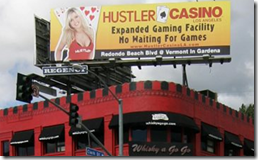
Above: A Regency billboard on top of the Whisky A Go Go.

This case involved the owner of a building on Sunset Boulevard in West Hollywood that houses the famed “Whiskey A Go Go” Bar, which rented the building rooftop to a billboard advertising company (Regency). After a possessory/ownership dispute erupted over the property and billboard-related improvements, landlord filed an unlawful detainer action to which tenant filed a motion to quash on the theory that a U.D. action was inappropriate in light of an ownership controversy. Eventually, the trial court issued a tentative ruling in tenant’s favor, but landlord filed a request for dismissal of the complaint before a final ruling issued on the quash motion. Later, landlord filed a second action against tenant for breach of lease, trespass, and interference that is still on-going in nature. Tenant (Regency) then sought to recover $390 in costs and $31,227.50 in attorney’s fees in defending the dismissed first action. The trial court denied all the requests, determining that any costs/fees recovery was premature until the second action determined which company ultimately prevailed.
Regency appealed both the denial of costs and fees.
Regency won the costs challenge, but lost the attempt to obtain an attorney’s fee award at this juncture.
Regency was entitled to $390 in costs because a voluntary dismissal by plaintiff, whether with or without prejudice, entitles the defendant to recover costs. (Santisas v. Goodin, 17 Cal.4th 599, 621 (1998) [one of our Leading Cases]; Cano v. Glover, 143 Cal.App.4th 326, 331 (2006).)
However, the same conclusion did not follow with respect to Regency’s fee request. (In a footnote, the appellate panel found Civil Code section 1717 was not applicable—namely, the Santisas bar—because landlord’s U.D. action sounded in tort because it sought recovery for tortious holding over after expiration of a lease. Drybread v. Chipain Chiropractic Corp., 151 Cal.App.4th 1063, 1076 (2007).) The crucial concern is whether one side achieved its litigation objectives. (See Chinn v. KMR Property Management, 166 Cal.App.4th 175, 192 (2008); Silver v. Boatwright Home Inspection, Inc., 97 Cal.App.4th 443, 452 (2002).) The trial court’s refusal to award fees was no abuse of discretion given that there was an on-going, unresolved dispute between the parties that had not yet been resolved in Regency’s favor. Put another way, no prevailing party had yet been determined. On appeal, Regency tried to argue it did prevail based on the quash motion ruling in the first action, but this contention was rejected based on its own acknowledgment at another point in the court below that landlord dismissed the action prior to the formal ruling on its motion to quash. “It would be unfair to permit Regency to switch courses now.” (Slip Op., at p. 9.)